


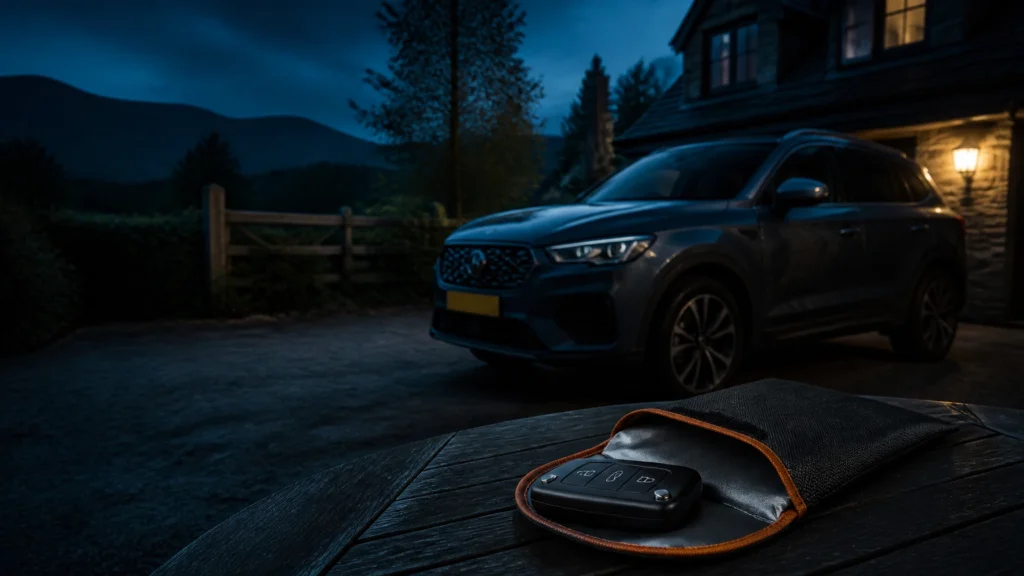
Keyless car theft is not limited to expensive cars or large cities. If your vehicle unlocks when you touch the handle, starts with a push button, or uses a proximity smart key, it may be exposed to more than one type of electronic theft.
The good news is that you can complete a basic risk assessment at home tonight. Use the checklist below to identify your vehicle’s likely weak points, then build protection in layers rather than relying on one device.
First: does your car have a keyless system?
Your car may be vulnerable to keyless theft if it has one or more of these features:
- The doors unlock when you touch the handle while carrying the key.
- The car locks automatically when you walk away.
- The engine starts with a push button rather than a traditional ignition barrel.
- Your key fob does not need to be removed from your pocket or handbag.
- The vehicle manual refers to “smart entry”, “proximity entry” or “passive entry”.
A car can still be targeted through other methods if it does not have keyless entry. OBD-based key programming theft, stolen keys and weaknesses in vehicle electronics can affect a wider range of modern vehicles.
Your five-minute keyless car theft risk check
This check cannot prove that your car is safe or unsafe. It gives you a practical indication of the security features and habits that may need attention if you want to reduce the risk of keyless car theft.
1. Test how far away the key can operate
Stand beside your vehicle with the key fob in your hand. Confirm that it unlocks and starts normally, then repeat the test with the key:
- Inside your home.
- Near the front door.
- Beside a downstairs window.
- In the room where you normally leave it overnight.
If your vehicle responds while the key is inside the house, that does not automatically confirm a relay vulnerability. However, it does show that the signal is reaching the car and that storing the key close to an external door or window is poor security practice.
Do not spend time trying to find a “maximum range”. The important question is whether your key is routinely stored close enough to an outside wall, door or window for its signal to be reached.
2. Check where every key is stored
Find your main key, spare key and any additional fobs. Ask yourself:
- Are they left on a hallway table?
- Are they stored near the front door?
- Are they close to a ground-floor window?
- Is a spare key kept in a garage, porch or vehicle?
- Are the keys left inside luggage when you are staying away from home?
Move all keys away from doors and windows, preferably to a central location inside the property. Remember that a spare key can be just as valuable to a thief as the key you use every day.
For holidaymakers, avoid leaving keys on a hook beside the entrance of a holiday cottage or letting accommodation. Keep them inside a signal-blocking pouch and away from external walls whenever you are not driving.
3. Test your Faraday pouch or box
A signal-blocking pouch is only useful if it blocks the signal properly. Test it before relying on it:
- Place the key fob fully inside the pouch and close it securely.
- Stand beside your locked vehicle.
- Try to unlock the car using the handle or remote.
- If your vehicle has push-start, check that it does not recognise the key when you try to start it.
- Repeat the test with the spare key and any second pouch.
Some vehicles have an emergency method for recognising a key fob when its battery is flat. This can produce different results from normal operation, so check your owner’s manual if you are unsure.
Replace a pouch that is worn, poorly sealed or failing the test. A metal storage box may also help, but it must close properly and be tested in the same way.

4. Confirm whether keyless entry can be switched off
Some manufacturers allow you to disable passive keyless entry or put the fob into a sleep mode. The method varies between makes and models.
Check your vehicle manual or the manufacturer’s official guidance. The National Crime Agency guidance on keyless vehicle theft and Secured by Design vehicle security advice also provide useful, trustworthy information. If you cannot find the setting, ask a dealer or qualified automotive specialist rather than guessing. Turning off keyless entry may still leave remote locking or push-start functions operating differently, depending on the vehicle.
5. Locate the OBD port without dismantling anything
The OBD, or On-Board Diagnostics, port is normally located beneath the dashboard near the steering column. It allows diagnostic equipment to communicate with the vehicle’s electronic systems.
A thief who gains entry may use the OBD port and specialist equipment to attempt car key programming or other electronic manipulation. This is not the same as a relay attack, and it is not relevant to every vehicle, but it is an important part of a wider security assessment.
You can check:
- Where the OBD port is located.
- Whether it is clearly exposed.
- Whether a protective cover or lock guard is already fitted.
- Whether your vehicle has known OBD security concerns.
Do not cut wires, move the port or remove dashboard panels yourself. Ask a trusted auto locksmith, auto electrician or dealer about an OBD lock guard or professional relocation.
What to do if your car looks vulnerable
A Faraday pouch is a sensible first step, but effective protection works best in layers.
Layer one: reduce the signal risk
Start with simple daily habits:
- Keep all keyless fobs in tested Faraday pouches.
- Store the pouches away from doors and windows.
- Do not leave keys in a porch, conservatory or garage adjoining the house.
- Check that the car is locked before leaving it.
- Use your manufacturer’s keyless sleep or disable function if available.
- Test pouches periodically, particularly after heavy use.
These steps reduce the chance of signal amplification being used against your vehicle, but they do not protect against every theft method.
Layer two: add a professionally installed immobiliser
A discreet aftermarket immobiliser adds a separate authorisation step before the engine can start. The CAN–Phantom immobiliser installation service from MH Automotive uses a coded sequence entered through existing vehicle controls.
This type of protection is designed to help prevent a vehicle from being driven away even if criminals have:
- Amplified or cloned the key signal.
- Gained entry through the vehicle.
- Attempted OBD-based programming.
- Obtained a valid key.
Installation is vehicle-specific and should be completed by a competent specialist who understands the car’s CAN-Bus network and existing security systems. MH Automotive offers mobile CAN–Phantom installation across Carlisle, Cumbria and the wider Lake District, with typical installation taking one to two hours, depending on the vehicle.

Layer three: protect the OBD and physical vehicle
Ask about an OBD protective cover, lock guard or relocation where appropriate for your make and model. A visible steering wheel lock, secure parking and good exterior lighting can also increase the time and effort required to steal the vehicle.
Where possible:
- Park in a garage or behind a physical barrier.
- Use a well-lit, overlooked parking space.
- Keep the vehicle locked, even when parked at a holiday property.
- Do not leave documents, spare keys or personal details inside the car.
- Consider a steering wheel lock for an additional physical deterrent.
Layer four: install a hard-wired dash cam
A dash cam will not stop a thief starting the vehicle, but it can provide evidence of suspicious activity, attempted entry or damage. A front-and-rear system with parking mode can monitor the vehicle while it is parked, subject to the equipment and installation being suitable for your car.
Professional dash cam fitting from MH Automotive includes hidden wiring, fuse-box hardwiring and safe power management. This avoids trailing cables and helps prevent battery drain or interference with the vehicle’s electronics.

Layer five: consider a vehicle tracker
A tracker does not prevent theft, but it may improve the chances of locating the vehicle after it has been taken. Check the tracker’s subscription requirements, installation method and your insurer’s conditions before choosing one.
A tracker is most effective as part of a wider plan that already includes signal protection, physical security and an immobiliser.
What if you have lost a key?
If a key has been lost or stolen, do not assume that locking the vehicle is enough. Ask a qualified specialist to check whether the missing key can be removed from the vehicle’s authorised key list.
MH Automotive provides mobile car key programming for replacement and spare keys, including transponder, remote and smart key systems. Using dealer-level diagnostic and programming equipment, the team can also investigate immobiliser and key-recognition problems across many makes and models.
If your vehicle has suffered an electronic fault or a previous attempted theft, ECU and module programming may also be required to synchronise the ECU, BCM, immobiliser or other modules correctly.
Your tonight checklist
Before you go to bed, complete these actions:
- Confirm whether your car has keyless entry and push-start.
- Find every key and spare key.
- Move keys away from doors and windows.
- Place them inside tested Faraday pouches or a suitable signal-blocking box.
- Check that the car is locked and the alarm is set.
- Look up whether keyless entry can be disabled.
- Locate the OBD port and consider professional protection.
- Use a steering lock or other physical barrier if appropriate.
- Arrange an immobiliser assessment if the vehicle is desirable or frequently parked outside.
- Consider a hard-wired dash cam and tracker as additional layers.
Get a no-obligation vehicle security check
Keyless car theft is a broader risk than relay attacks alone. Signal amplification, OBD access, unauthorised car key programming and stolen keys can all require different countermeasures. A proper assessment helps you decide which layers of protection are most appropriate for your vehicle, your parking habits and your overall exposure to keyless car theft.
With more than 20 years of technical experience, dealer-level equipment and a mobile service covering Carlisle, Workington, Whitehaven, Penrith, Cumbria and the Lake District, MH Automotive can assess your vehicle and recommend practical protection without unnecessary upgrades.
Contact MH Automotive for a no-obligation discussion and a clear, fixed-price solution where possible. You can also call 07376 977 364 or email greg@mhautomotive.co.uk.

Frequently asked questions
Are all keyless cars vulnerable to keyless car theft?
No. Risk varies by make, model, software and security configuration, but every keyless vehicle should use sensible signal protection and layered security.
Does a Faraday pouch stop relay attacks?
A correctly closed and tested pouch can block the key’s wireless signal, reducing the risk of signal amplification. It does not protect against OBD theft, stolen keys or forced entry.
Can a non-keyless car be stolen using the OBD port?
Potentially, depending on the vehicle. OBD-based theft requires physical access and is model-specific, so ask a qualified specialist about an OBD guard or relocation.
Does a CAN–Phantom immobiliser replace a Faraday pouch?
No. The pouch protects the key signal, while the immobiliser adds a separate barrier to engine start-up. Using both provides broader protection.
Will a dash cam prevent my car being stolen?
No. A dash cam can record activity and provide evidence, particularly with parking mode, but it should be combined with an immobiliser, physical security and a tracker.
Can MH Automotive install security equipment while I am away on holiday?
Yes. MH Automotive provides mobile vehicle electronic and security services across the Lake District and wider Cumbria, subject to vehicle, location and appointment availability.
